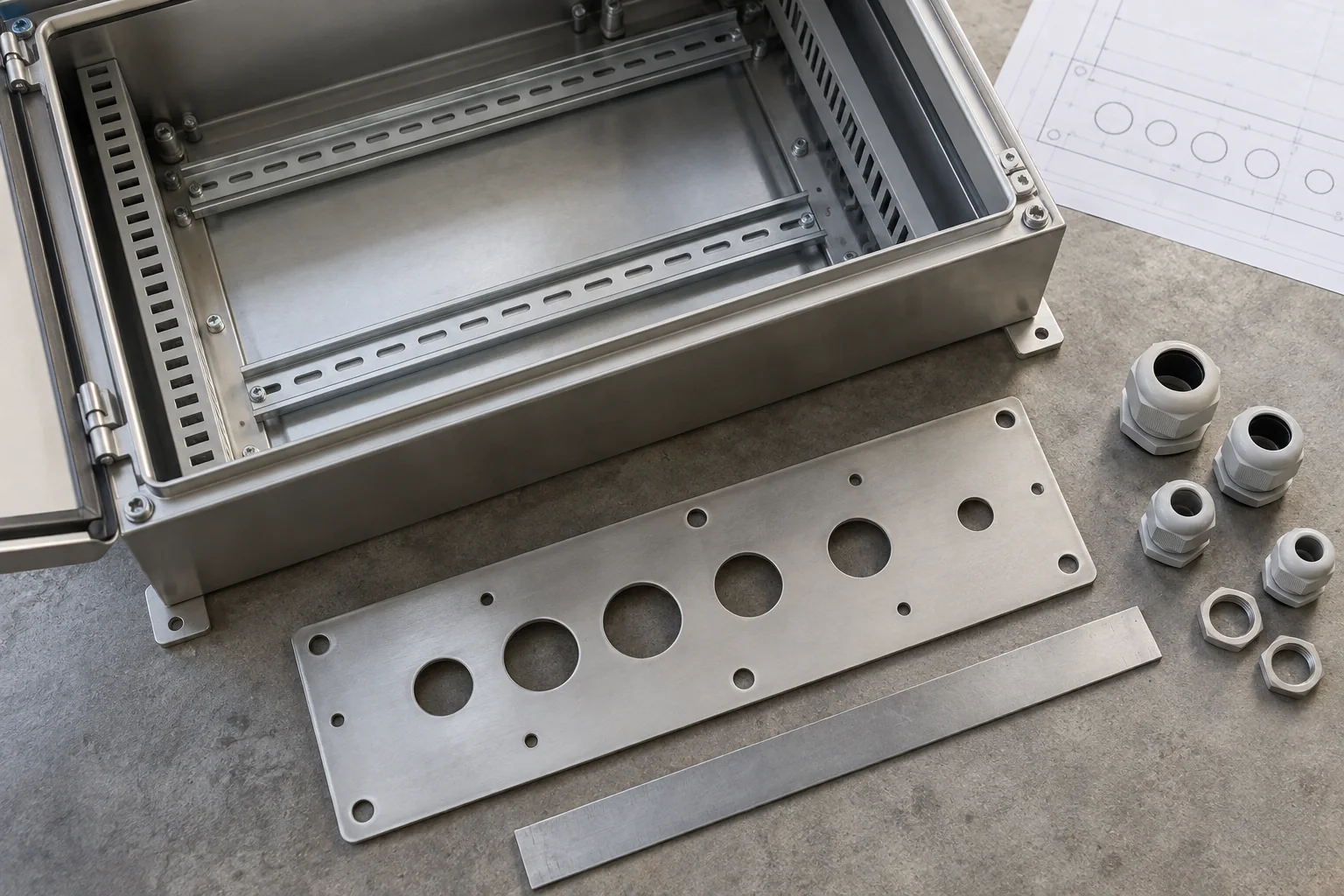
Start with an internal arrangement
Request an arrangement drawing showing mounting plates, rails, component envelopes, wiring routes, cable bend requirements and access for replacement. External cabinet dimensions do not define usable installation space. Include the door swing, front and rear access, neighbouring equipment and the route used to remove a failed component.
Freeze the interfaces
Identify cable quantities, sizes, entry faces, gland or transit systems and segregation requirements. Include earthing and bonding details for the responsible electrical designer to approve. Ask the supplier to show the proposed cut-outs and their relationship to structural members, seals, internal equipment and mounting hardware.
Control modifications
nVent’s alteration guidance requires penetrations to follow the relevant device manufacturer’s instructions and calls attention to rating compatibility and clearance around seals. Obtain instructions for the exact enclosure and accessories. Decide which work is performed at the factory, panel shop or site, and who confirms the resulting rating and approval position.
Match cable entries to the complete rating
Record cable outside diameters and match each gland’s sealing range, thread and installation instructions. Include compatible blanking devices for spare holes. Coordinate entry position, drainage and service access with the installation designer; a gland’s individual rating does not establish the rating of the finished assembly. If a fan, filter or window is added later, obtain confirmation of the complete configuration before release.
Specify the delivered package
List mounting plates, plinths, rails, door stays, glands, blanking plugs, cooling units, bonding components and fixings as included, excluded or by others. Compare quotations on that complete schedule. Request approval drawings before production, together with a change-control process for late modifications.
Inspect against the approved revision
At receipt and handover, check model identification, accessory quantities, cut-outs, finish, seals and drawing revision. Record discrepancies before installation proceeds. Where an inspection identifies a departure affecting performance, obtain the responsible reviewer’s resolution rather than treating a site adjustment as automatically acceptable.
Further reading & sources
General procurement guidance. Confirm project-specific requirements with the responsible design team and the supplier.
Use this on your project
Download the requirements and delivery templates or record a comparison against your specification.